
Contemporary Artists Reveal What Revision Really Looks Like
Revision in contemporary art is the purposeful reconsideration of a work: artists alter, remove, reorder, or reinterpret material as an idea develops. It is not simply correcting mistakes or polishing a finished object. Painters may paint over earlier images, writers may restructure a manuscript, and performance or media artists may revise through rehearsal, editing, or new versions. The examples of Gerhard Richter, Kara Walker, and multimedia artist William Kentridge show how revision can preserve traces of earlier decisions while changing a work’s meaning. Their practices also reflect a broader point: making art is iterative, and the visible result may contain evidence of its own development.
Revision as a Contemporary Art Practice
In everyday language, revision means reviewing and changing something. In art, it is a process of reworking a developing or completed work in response to intention, material, chance, or new understanding. The artist and educator John Dewey, in Art as Experience, described artistic creation as a dynamic interaction between maker and material rather than the execution of a plan untouched by experience. That perspective helps explain why a change in a painting, film, or performance can become part of the work’s meaning rather than merely a step toward a predetermined endpoint.
Revision takes different forms: physical alteration, such as painting over an image; structural change, such as recutting a film; and conceptual reframing, such as presenting an older work in a new context. It matters because audiences often encounter an artwork as if it were a finished, stable object, while the artist’s process may involve uncertainty, discarded options, and repeated decisions. The artists below reveal how those decisions can remain visible—or become meaningful precisely because they are concealed.
Revision is more than correction
Correction aims to fix an error against an established standard; artistic revision may instead question the standard, change the work’s direction, or deliberately retain an inconsistency. A revised composition might become less resolved in a conventional sense but more expressive or politically pointed. This distinction connects studio practice with editing and performance: in each, a maker evaluates what a work is doing and decides whether its current form serves the intended effect.
Gerhard Richter’s Revision Through Overpainting
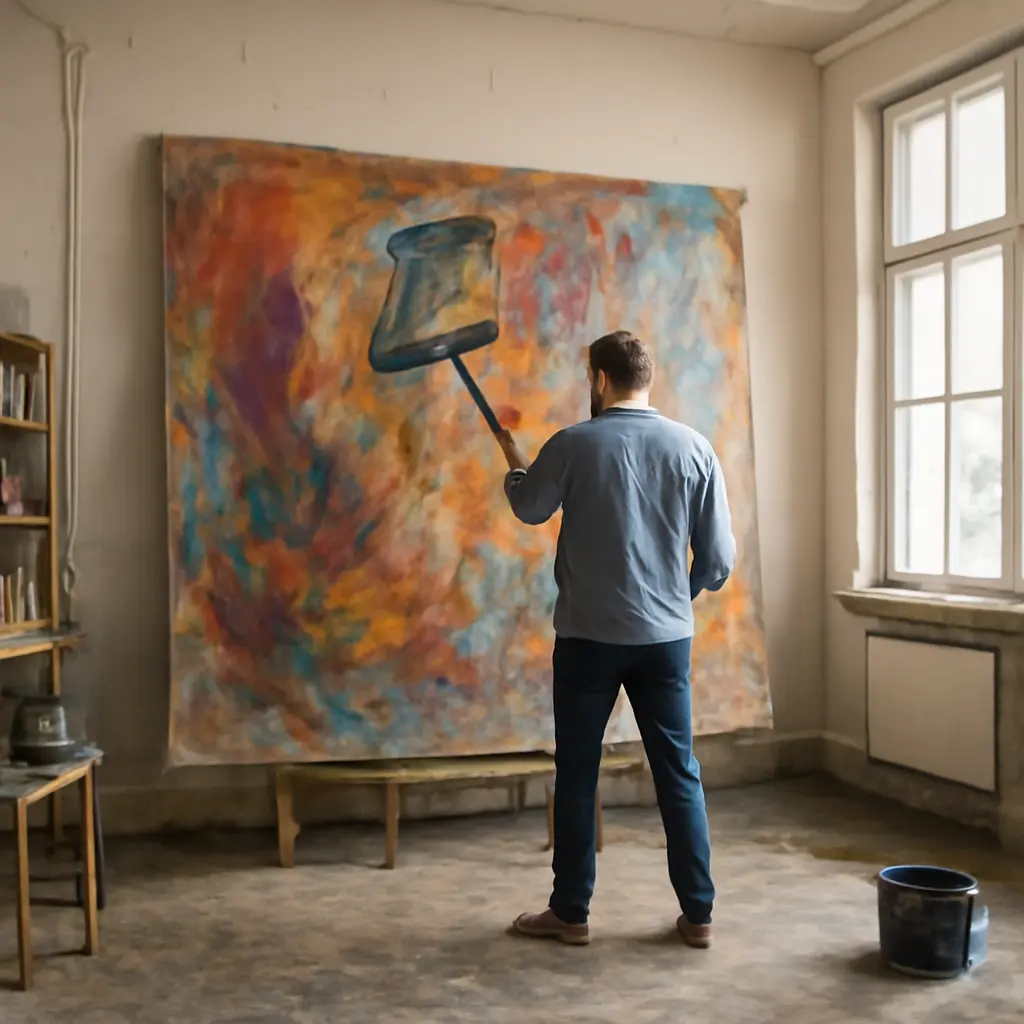
German artist Gerhard Richter has used overpainting—the application of new paint over existing paint—as a way to interrupt and reshape an image. The Museum of Modern Art describes his practice as spanning photography-based paintings, abstraction, and other approaches, resisting a single fixed style. In many abstract works, Richter drags a large squeegee across layers of paint. The tool reveals, smears, and covers earlier passages, so the surface records both the act of revision and the partial loss of what came before.
Overpainting makes decisions visible
Overpainting is the process of covering part or all of an existing painted surface with another layer. In Richter’s work, it does not necessarily erase the earlier image completely: colors and marks can reappear through later layers, creating a surface in which the past is present but unstable. The result challenges the idea that a painting is produced in a single decisive gesture. Instead, the viewer sees a sequence of decisions compressed into one object.
This practice also shows how revision can depend on material behavior. Wet paint can mix, slide, or resist the artist’s tool; the outcome is not always fully predictable. The artist responds to what the surface does, and that response becomes another stage in the work. Richter’s method therefore connects deliberate revision with chance: neither complete control nor pure accident explains the final image.
Erasure can become a compositional choice
Erasure is a related but distinct strategy: an artist removes, obscures, or suppresses material so that absence becomes part of the composition. In painting, an erased passage may survive as a faint outline or a change in texture. In Richter’s abstract canvases, covering and exposing can function together, directing attention toward the tension between what is seen and what remains hidden. This is useful context for understanding revision as a record of both addition and subtraction.
Kara Walker’s Revision of Historical Images
Kara Walker, an American artist whose work confronts race, gender, violence, and the afterlives of slavery, revises familiar visual languages to expose what they leave out. She is widely known for large-scale black-paper silhouettes that recall nineteenth-century cut-paper portraiture. The medium’s apparent simplicity is deceptive: Walker uses the recognizable form to stage disturbing, ambiguous scenes that challenge viewers to examine the racial stereotypes and historical fantasies embedded in popular imagery.
Reframing inherited visual conventions
Reframing means changing how an image or story is interpreted by placing it in a different context or altering its point of view. Walker’s silhouettes draw on a historical art form associated with genteel portraiture, but their scenes unsettle that association. By bringing violence and caricature into a format that can initially seem decorative, she makes the viewer confront how attractive or familiar images can carry painful histories. Revision here is conceptual: the artist does not merely update an old image but changes the terms on which it can be read.
That approach makes the audience part of the interpretive process. The silhouettes withhold facial detail, so viewers may initially rely on cultural assumptions to identify figures and relationships. Walker’s use of ambiguity makes those assumptions visible and open to scrutiny. The work’s meaning thus develops through the friction between its elegant form and its unsettling subject matter.
Historical context can be revised without being erased
Historical revision in art does not have to mean replacing one account with a supposedly final version. It can mean exposing omissions, conflicts, or inherited distortions in the images through which history is remembered. Walker’s practice connects with a wider contemporary-art concern: who is represented, who controls the representation, and how images shape public memory. Her work demonstrates that revision may operate on a cultural archive as well as on a physical surface.
William Kentridge’s Revision Through Drawing and Film
South African artist William Kentridge is known for animation made from charcoal drawings that he repeatedly alters and films. Rather than replacing each drawing with a clean new sheet, he often erases and redraws on the same surface. The resulting marks retain traces of earlier images. The Metropolitan Museum of Art has discussed his animated films in relation to this process, in which drawing, erasure, and filming combine to make change visible over time.
A palimpsest records earlier versions
A palimpsest is a surface that has been reused but still bears traces of previous writing or images. Kentridge’s drawings function in a similar way: an erased figure may leave a shadow or smudge beneath a new one. When successive drawings are filmed, viewers see the image transform while remnants of its past persist. Revision becomes not only a method of producing the animation but also a subject: memory, loss, and historical change appear in the marks themselves.
The technique differs from conventional animation, which commonly uses separate frames to create movement. Kentridge’s process makes the physical labor of alteration part of the visual experience. Each new version is connected to the old one rather than entirely independent of it. This offers a vivid example of how a medium’s technical constraints can shape an artwork’s ideas.
Time-based art makes revision legible
Time-based art includes work that unfolds through duration, such as film, animation, sound, and performance. In these forms, revision can happen through repeated takes, reordered sequences, altered sound, or changes made between performances. Kentridge’s films are especially clear examples because they preserve the transition between images. In contrast, a conventional edit may conceal its revisions so that the finished sequence appears seamless. Both strategies are artistic choices: one foregrounds construction, while the other directs attention toward the completed experience.
What Artists’ Revision Practices Share
Richter, Walker, and Kentridge work in different media, but their approaches share several principles. Revision can be physical, conceptual, or temporal; it can reveal past decisions or deliberately hide them; and it can change the viewer’s understanding of an image without removing its history. The distinction between revision and erasure is especially important: artists may cover a mark, yet its trace can continue to shape the new work.
- In painting, revision can layer, scrape, cover, or expose material.
- In image-making, it can reframe familiar conventions and challenge inherited narratives.
- In film and animation, it can emerge through redrawing, recutting, sequencing, or performance.
- Across all these forms, revision can make process itself part of the work’s meaning.
There is no single statistic that measures how much revision artists undertake across contemporary art; practices and media differ too widely for a meaningful universal count. Instead, the works themselves provide evidence of process. Museum accounts and artist documentation can help distinguish what is known about a method from what viewers infer from the finished surface. For a visual comparison, a useful chart would map each artist against three features—whether revision is visible, whether earlier versions remain legible, and whether the change is primarily material or conceptual.
Conclusion: Revision Keeps Art Open to Change
Contemporary artists reveal revision as more than a final-stage polish. Richter’s overpainting turns concealment and chance into composition; Walker’s silhouettes revise the ways historical images are read; and Kentridge’s altered drawings make memory and transformation visible in time. Together, their practices show that an artwork can hold several versions of itself at once, whether through layers on a canvas, contested cultural references, or traces left by an erased image.
For viewers, noticing revision offers a way to look beyond the finished surface and ask how a work was made, what it leaves visible, and whose perspective it changes. Explore museum collections and artist interviews alongside the artworks themselves, and compare how different media make revision either conspicuous or nearly invisible.
Sources: John Dewey, Art as Experience, 1934, https://archive.org/details/artexperience00dewe; The Museum of Modern Art, “Gerhard Richter,” https://www.moma.org/artists/4903; The Metropolitan Museum of Art, “Gerhard Richter,” https://www.metmuseum.org/art/collection/search#!?q=Gerhard%20Richter; The Museum of Modern Art, “Kara Walker,” https://www.moma.org/artists/7679; Tate, “Kara Walker,” https://www.tate.org.uk/art/artists/kara-walker-2674; The Metropolitan Museum of Art, “William Kentridge,” https://www.metmuseum.org/art/collection/search#!?q=William%20Kentridge; Tate, “William Kentridge,” https://www.tate.org.uk/art/artists/william-kentridge-2697
Related Post
How Photography Changed the Role of Painting
Photography changed painting by taking over much of its traditional work as a tool for [...]
Portraiture Today Beyond Traditional Poses And Expressions
Portraiture is the visual representation of a person, group, or performed identity, traditionally organized around [...]